
Six Summer Days of Music

I spent last week at a summer music camp put on by WCAMS, the West Coast Amateur Musicians Society, pronounced “Wickams”. My goal in writing this is to influence a few readers in the direction of attending this sort of thing if there’s one near you. You might be a candidate if you partake of some subset of: Loving music, getting old, being female, worrying about mental fitness, and having time available to invest as you please rather than as you must.
The facts · 250 attendees, a couple of dozen faculty (all professional musicians), a lovely waterfront venue at a swanky boarding school campus in an isolated small town. The picture above is the cover of the camp booklet.

On the way to the camp.

This space, while the camp is running,
usually contains at least one person
or group emitting
music.
Let me should expand on that list above.
If you love music, there are multiple concerts per day, some quickies by whoever wants to between sessions, some highly polished offerings from the faculty. They all offer pure sound; unamplified and in music-friendly spaces. The volume and balance and tone are achieved by the performers’ technique and love, nothing is digitized or amplified.
Then there are the concerts you’ll be practicing for and playing in.
The most common hair color was gray. I mean, there were kids and teens and thirtysomethings, but I’d say more than half the people were at least semi-retired. Not sure why, but it may have to do with retirees having spare time and no childcare duties, and music having been more widely taught back when us Olds were kids, and the price, $1300 Canadian (about a thousand US) per person, bed and board and music all-in. The venue was a private boarding school, thus “bed and board” was of a school-dorm standard, clean and complete but very basic.
There were attendees who were unsteady on their feet and needed a golf-cart to get around and help on the stairs, but they could still play the hell out of their fiddle or trombone or whatever.
The place was a matriarchy. My small string ensemble had three men and ten women, my cello seminar eight and two. Don’t have a glib explanation except that music teachers were plentiful, and women are over-represented in the teaching professions. So, it’s a space where (I’m guessing of course) women are less likely to feel crowded out or bossed around.
As for mental fitness while aging, the research is in and it’s not subtle. Music, both listening and performing, is good for your mind/brain generally, and specifically reduces the risk of dementia.

For privacy reasons, we were all asked not to share photos from the camp in public, but I think this one is safe.
The music · I found the choice of tunes contrarian; did not hear a single Mozart chestnut. I think this works because everyone at the place is musically literate and many are erudite; they’ve heard enough Mozart classics. Let me sort the choices. One basket: Works written in the attendees’ lifetimes, including a lot of female composers and Canadian stuff. Another: Oddments from the back pages of the usual titans, for example Beethoven’s Septet (his first big hit, he came to hate it), and the graceful but weird second movement of Stravinsky’s Concerto in D. Another: Popular-music classics arranged for acoustic instruments. I heard (and will have more to say about) Bohemian Rhapsody for woodwind quintet, Cohen’s Hallelujah for seven violas, and the Cowboy Junkies’ Cold Tea Blues for four female voices and ukulele.
The big final choir-and-orchestra blowout, with 110 people on stage, was Brahms’ Schicksalslied, which I bet almost none of the people reading this have never heard of (I hadn’t).
And also Bach. Because of course.
How it works · You join as many ensembles as you care to. Most people will find themselves in one chamber group or another, an orchestra or choir, and some sideline track like for instance, Early Music, Celtic, or Vocal Jazz. The organizers try to get the music mailed out a few weeks before the camp, but some lags and some only arrives when you hit the first session on Monday. You get five hours of rehearsal and then you perform it on Friday night or Saturday.
Obviously this calls for quite a bit of practice; there’s plenty of space for that. As you walk from wherever to wherever around the joint, you always hear the call of some instrument or voice, often running repeatedly through a tricky bit. Noobs join as many groups as they can fit in the schedule. Veterans have learned to dial it back a bit; I took their advice, signed up for only five tracks and performed only twice.
All this is a pretty fucking intense experience, let me tell you. And here’s what I’ll take away: The radiant and heartfelt smile on the face of nearly every musician when they finish their performance. And basically every piece gets thunderous applause, with hollering. Usually but not always deserved.
My adventure · I am not particularly gifted at music. I’m old and have pursued the cello on and off since I was a kid, with much more off than on and multiple no-cello decades. What happened was, my wife Lauren is a gifted singer with a powerful soprano who enjoys participating in choral music. Her choir buddies have been encouraging her to come to WCAMS for years. I wanted to support her and it sounded like fun, so I ended a 25-year gap and started cello lessons again last October. It’s been painful clawing my way back toward my previous level of skill, which was never that great. But WCAMS makes it clear that beginners are welcome, will be encouraged and supported. So we signed up.
Anyhow, my cello skills were solidly in the bottom quartile of the couple of dozen cellists in attendance. Which was humbling but not a problem actually, because of that encouragement and support I just mentioned.
But during that 25-year cello gap I took up the study of West-African and Afro-Cuban drumming, with weekly lessons, and then for the last year or so, regular participation in a multi-hour by-invitation-only weekly drum jam. Judging one’s own talents is tough, but I seem to get musically further with less work on the drumming side. I even get the occasional spontaneous compliment that isn’t just politeness; something that has rarely-to-never happened in my cello career. So I see drums as my primary musical hobby.
But WCAMS doesn’t have an African-music group; thus my cello lessons. Then when we got the initial program I spotted the Celtic track, and I know that music comes with drums.
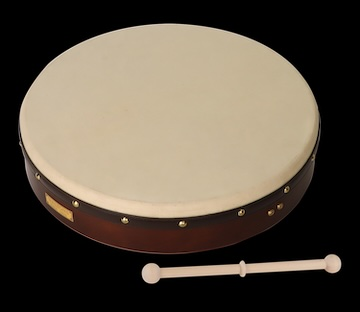
So, without asking anyone whether it was a good idea, the week before the camp I rented a bodhrán. It came with a “how to play” DVD that I watched all of, then I went and typed “bodhrán practice music” into YouTube and of course there’s plenty. After a few hours I was confident that I could keep up if they didn’t go too fast (they didn’t). It’s pretty easy to play even though the actual strike-the-drum motion is eccentric, unlike any other percussion instrument of my acquaintance.
I should mention that “bodhrán” is pronounced with the “dh” silent, “bo” as in “bother” and “rán” as in “roan”.
At the opening-night gathering, I tracked down Amy, the Celtic-track leader, and asked if it would be OK if I showed up with the drum. She was welcoming (everyone at WCAMS seems permanently welcoming). When we struck up the first tune at the beginning of our Monday gathering, she looked a little nervous but when I joined in she nodded emphatically; it turned out the last time a fresh face equipped with a bodhrán had turned up, they couldn’t actually find or stay with the beat.
Anyhow, I joined Amy’s Beginner and Advanced classes, learned a whole lot about Celtic music (starting from zero helps), and had more fun than ought to be legal. Got unsolicited compliments. Our performance was at the wind-up party after the big final Brahmstravaganza, and the crowd yelled and whistled, dancing broke out. I was full of joy — I think the whole band was. I’ll never forget it.
Musical take-aways · Here are the ones that I can still hear when I think back on them.
The woodwind quintet (who came to camp together as a group) played Bohemian Rhapsody on that little waterfront auditorium in the picture above. The arrangement was respectful and skilful and it highlighted what a wonderful, complex, piece of music that is. 100% by Freddy Mercury, who we all think of as Queen’s muscle, but this is a masterpiece by one of the last century’s top composers, any genre.
Arvo Pärt’s Spiegel in Spiegel by faculty cellist Marina Hasselberg and percussion pro Greg Samek, the latter on vibraphone. Exquisite, the notes suspended in space like rays of light.
Krunk, an Armenian folk song full of tragedy, on solo flute. Impossible to keep your eyes dry.
A Ukrainian song, lyrics by Shevchenko (there are lots, not sure which) delivered by Eric Hominick, a great singer and pianist who is about to retire from the West to East coast, and will be much missed.
Pride of Petravore is a hornpipe, the song that the awesome Amy Stephen used to launch the Celtic-music track. She projected the music on the whiteboard but wouldn’t make a print-out, insisting that we learn it so that when we opened our set we’d be focused on the music not the notes. It’s the song that Amy used to teach me I could get along on bodhrán.
I’ll be honest, I’ve always liked Irish-traditional music, have even been lucky enough to hear it in its natural habitat, a rundown pub in a remote corner of Ireland. But I’d never actually thought about it much. Now I have, and it’s deeper and stranger than I’d imagined. I’m pretty sure I’ll be investing time in it.
I really hope I get a chance to learn from Amy again, one way or another.
D.I.D. Choi is a young Canadian composer who, in his twenties, is off in LA, working on music for films and games and so on. His Remembrance, written in 2019, played by a wind ensemble, created a cloud of music magic in the air over the stage. I found my eyes closed, better to take it in. I’m going to suggest if you notice a concert anywhere near you with something by Choi, run don’t walk to the ticket booth.
I already mentioned the Cowboy Junkies’ Cold Tea Blues and it’s the one that hit me the hardest. The four singers had lovely light voices, the ukulele swung gracefully, and they did a bit of gentle choreography. The harmonies were fabulous. Anyone who’s heard this (and you can guess from the title) knows that this is not a happy song, but they shuffled that under the covers, casting a spell of light-hearted romance. Then when they planted the cruel razor sharp-hook at the end of the line of lyrics they’d been dangling so invitingly, there were audible gasps and cries of sorrow from the crowd. Never experienced anything like it.
Big band! · I’m old, but this is the music my parents listened to. I’d always thought of it as boring fuddy-duddy stuff. That was, until I got in a theater with good acoustics and a live 20-piece brass band. This stuff is loud and aggressive at a level that approaches Rock&roll, the arrangements are better, and the tunes are strong.
The way it works is, the different horn sections hand the melody and chorus back and forth, never the same twice, then somebody stands up and plays a solo, a pre-assigned number of bars. There was this one solo by a young trombonist that pretty well melted my mind. I wonder if this stuff retains any commercial viability, as in, is there somewhere I can go out and see it?
Anyhow… · Earlier today I bought the rental bodhrán, it’s a basic model and was pretty cheap. I think it’s full of happiness.
